
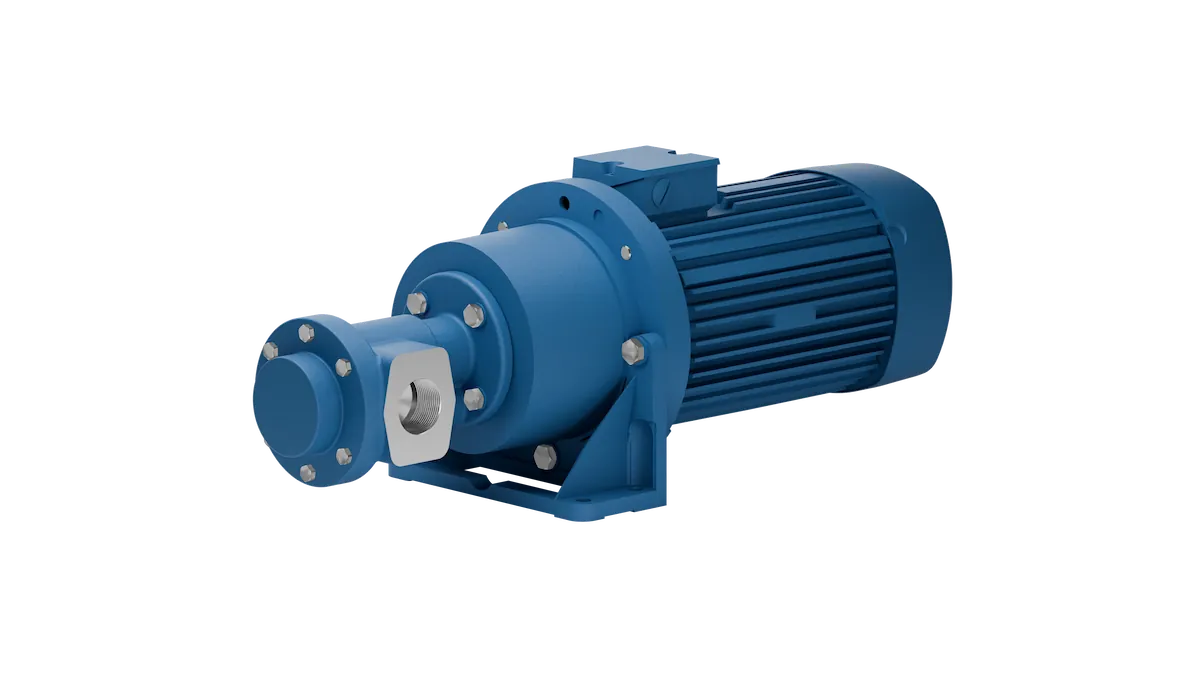
Gear pumps are strong when a clean, lubricating or viscous medium has to be delivered in a defined quantity. They show weaknesses with solids, with very thin and non lubricating media and wherever a large flow rate at low pressure is required.
This article helps you decide: it shows which advantages really count in practice, where the limits are and when another type of pump is the better choice.
The advantages in operation
Defined flow rate. A gear pump delivers a fixed volume per revolution. The flow rate therefore follows the speed almost directly and remains largely stable even with fluctuating back pressure. It can be set precisely via the speed, for example with a frequency inverter. This makes gear pumps attractive for lubrication circuits, circulation systems and metering tasks.
Viscous media. Where a centrifugal pump quickly loses efficiency with viscous oils, a gear pump keeps working reliably. As viscosity increases, the clearances actually seal better. It is important that speed and drive match the viscosity. For very viscous media of about 2,500 to 20,000 mm²/s, a slow running geared motor is therefore used.
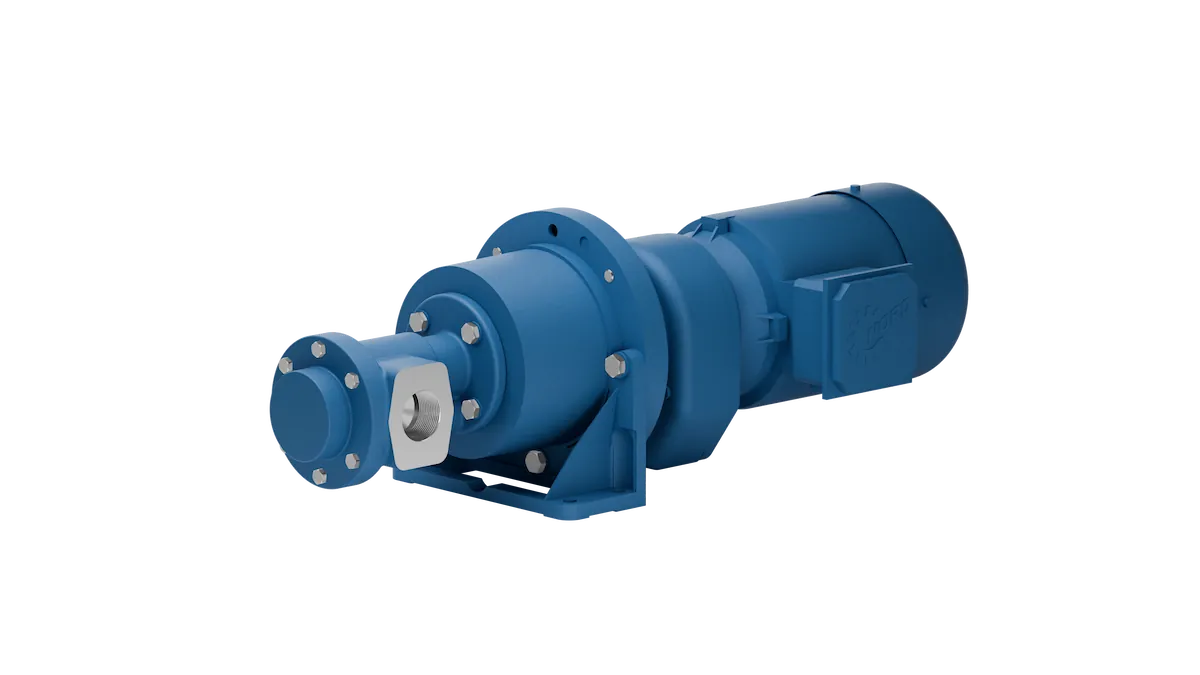
Self priming. Gear pumps can draw medium from a lower tank. This simplifies installation, for example when transferring from a drum or IBC. A short, leak tight and sufficiently sized suction line is required.
Robust and compact. With two gears, housing, bearings and shaft seal, a gear pump needs only a few parts. It is small, rarely fails in operation, and wear parts can usually be replaced easily.
Disadvantages and operating limits
Solids and abrasive particles. The tight clearances between gears and housing are the reason for the precise delivery, but also the biggest weak point. Sand, chips or pigments with hard particles wear the tooth flanks and housing, and the flow rate drops. Media containing solids are not suitable for gear pumps.
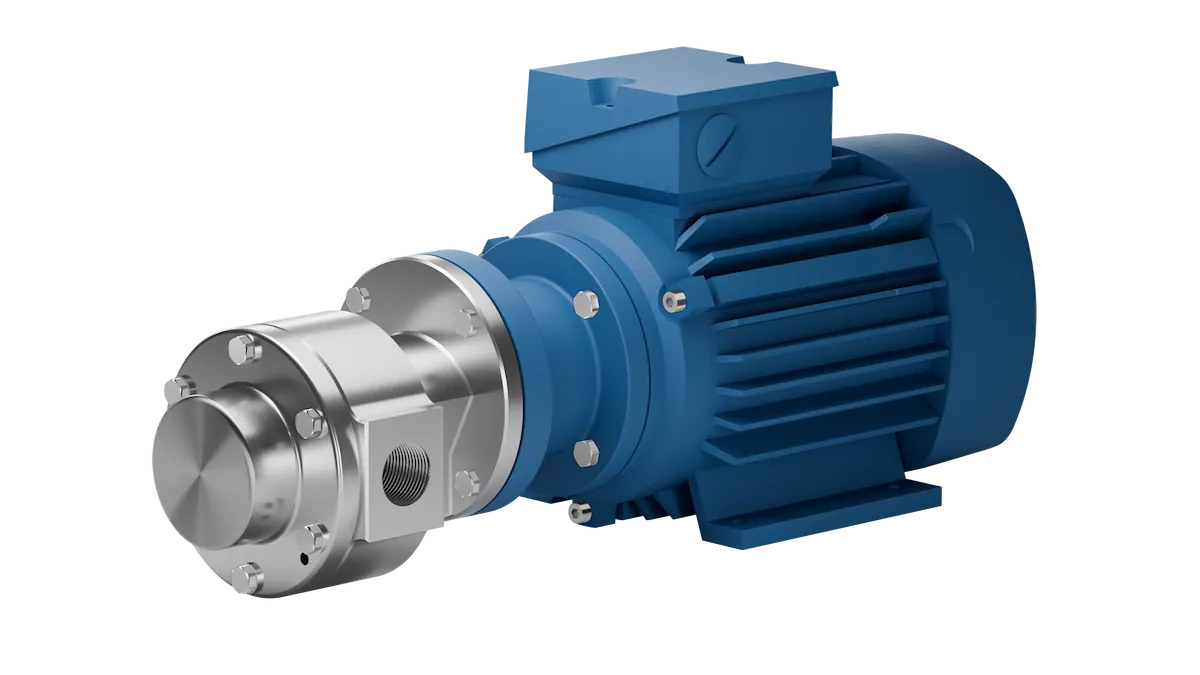
Thin and non lubricating media. At very low viscosity, more medium flows back through the clearances and the volumetric efficiency drops. Steel gears also need a certain amount of lubrication from the medium. For poorly or non lubricating, often water based media, there are therefore versions in stainless steel with PEEK gears. If the only task is to circulate large quantities of water, a Centrifugal pump is usually more economical.
Pressure limitation is a must. A gear pump keeps delivering as long as it runs, even against a closed line. Without a bypass or pressure relief valve, the pressure rises until something gives way. This is not a flaw, but it has to be taken into account when planning the system.
No dry running, limited gentleness. If the pump runs dry, lubrication and cooling are missing, and bearings and tooth flanks wear quickly. Shear sensitive media are stressed more in the tooth mesh than in an Impeller pump.
Gear pump or another type of pump?
| Requirement | Gear pump | Rather another type of pump |
|---|---|---|
| Oils, lubricants, thermal oils | Very well suited | Centrifugal pump only for very large flow rates |
| Viscous media up to approx. 20,000 mm²/s | Suitable, with adapted speed | Centrifugal pump reaches its limits early |
| Water in large quantities | Not very economical | Centrifugal pump |
| Media containing solids | Not suitable | Check impeller pump or another design |
| Defined, adjustable flow rate | Very well suited | Centrifugal pump only to a limited extent |
Operating range of Linn-Pumpen gear pumps
The Gear pumps from Linn-Pumpen cover flow rates up to 124 l/min at 1,450 min-1 . As standard, they are designed for viscosities from 1.4 to approx. 20,000 mm²/s and, depending on the version, for media temperatures from about -40 °C to +200 °C. For lubricating oils there is the cast iron version, for corrosive media stainless steel 1.4571 and for poorly lubricating media stainless steel with PEEK gears. We always agree applications close to these limits together with you.
Frequently Asked Questions
When is a gear pump better than a centrifugal pump?
With viscous media, when a defined and adjustable flow rate is needed and when the pump has to be self priming. For large quantities of thin media, the centrifugal pump usually has the advantage.
Can a gear pump pump water?
Yes, but not with every version. Water hardly lubricates, so stainless steel versions with PEEK gears are an option. For simply circulating large quantities of water, a centrifugal pump is more economical.
Does every gear pump need a pressure relief valve?
Yes. Either a bypass valve is integrated into the pump, which is possible on the cast iron versions, or a pressure relief valve is installed in the system.
Conclusion
For clean, lubricating and viscous media with a defined flow rate, the gear pump is often the best choice. With solids, large quantities of water or a risk of dry running, another design should be considered. Send us the medium, viscosity, temperature, pressure and flow rate, and we will tell you which pump suits your application.

