
Oil is the typical medium for a gear pump. It lubricates the gears and bearings, and the pump delivers it evenly and with minimal pulsation. Whether it is lubricating oil, heat transfer oil or heating oil, the two values that count most when choosing are:.
The viscosity determines the speed at which the pump can run. The temperature determines which shaft seal and which materials are suitable. This guide shows you the recommended values for Linn pumps and which operating data you should prepare for the design.
Why gear pumps are a good fit for oil
Linn-Pumpen manufactures external gear pumps. Two gears spin in the housing, take the oil into the tooth gaps and push it to the pressure side. The way this works in detail is explained in the article. What is a gear pump. The difference from the internal gear pump can be found in the article. Internal or external gear pump.
Oil is primarily characterized by its lubricating effect. The casting versions of Linn pumps are designed for clean, lubricating fluids, and that is exactly what most oils are. Typical media are mineral oils, synthetic oils, biodegradable oils and vegetable oils, lubricants, as well as diesel and heating oil. Solid particles and abrasive components must not be present in the oil.
The pumps are self-priming. However, dry running is not allowed, because the pump needs the medium for lubrication. Therefore, fill the pump with oil before the first start-up.
The viscosity determines the rotational speed
The more viscous an oil is, the slower the gear pump must run. At too high a speed, the tooth gaps no longer fill completely and the actual flow rate decreases.
Linn Pumps specifies fixed values for these applications. At 1,450 min⁻¹, that is, with a four-pole motor, the values apply up to 250 mm²/s for the small construction sizes F1 and F2 and up to 350 mm²/s for F3 to F5. With around 1,000 min⁻¹, it is possible to achieve values of up to 1,500 mm²/s, and with 700 min⁻¹, up to 2,500 mm²/s. Higher viscosities up to 20,000 mm²/s require rotational speeds of 500 to 200 min⁻¹. Linn Pumps only specifies these ranges after technical consultation.
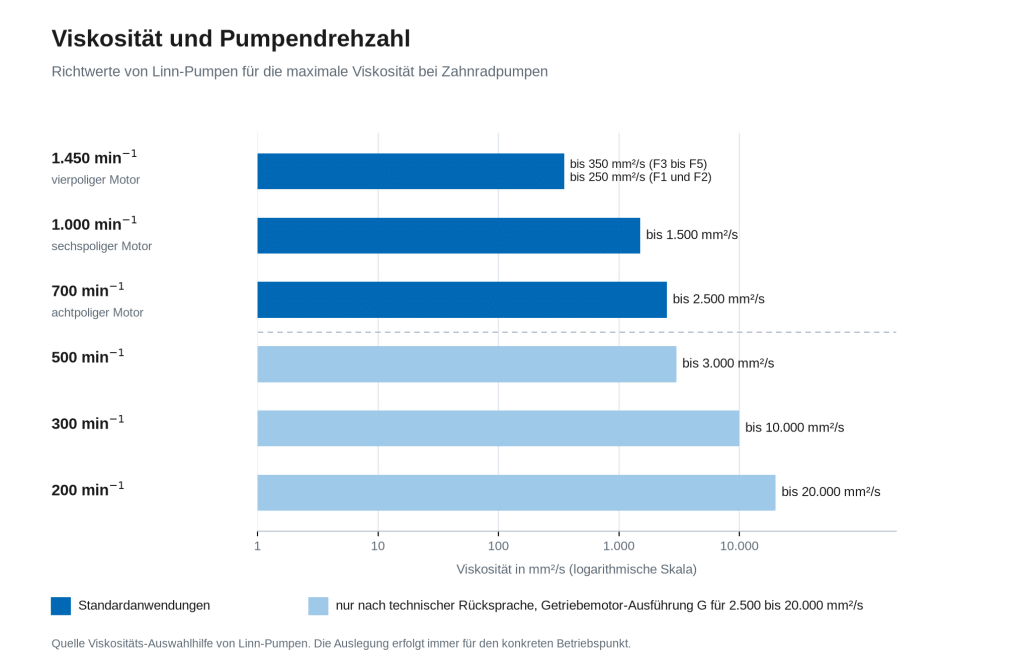
The viscosity is decisive in the coldest operating conditions. Oil becomes significantly more viscous at low temperatures. If an installation is running cold, the pump must also handle this condition. Therefore, when requesting the viscosity, please specify the viscosity at the minimum temperature and at the operating temperature.
For highly viscous oils with a viscosity of 2,500 to 20,000 mm²/s, there is the Gear motor version G. A spur gear motor reduces the pump rotation speed so that the viscous oil reliably fills the tooth gaps. If the viscosity is low, a standard motor with a slower speed, for example an eight-pole motor, is usually sufficient.
Even very viscous oils have a limit. Below 35 mm²/s, the maximum allowable pressure drops. The performance specifications in the data sheets for Linn pumps refer to hydraulic oil with 35 mm²/s at 50 °C. Overall, the F series covers viscosities from 1.4 to 20,000 mm²/s.
Choose the temperature and wave seal appropriately
The temperature of the oil is primarily responsible for the seal on the shaft. In the standard configuration, a radial shaft seal made of NBR seals the drive shaft. It is designed for operating temperatures ranging from −10 °C to 60 °C.
For hotter oils, other seals are available. FKM seals and sliding ring seals can be used up to 150 °C, while PTFE seals and graphite stoppers are suitable for temperatures up to 200 °C. The graphite package is not intended for stainless steel pumps.
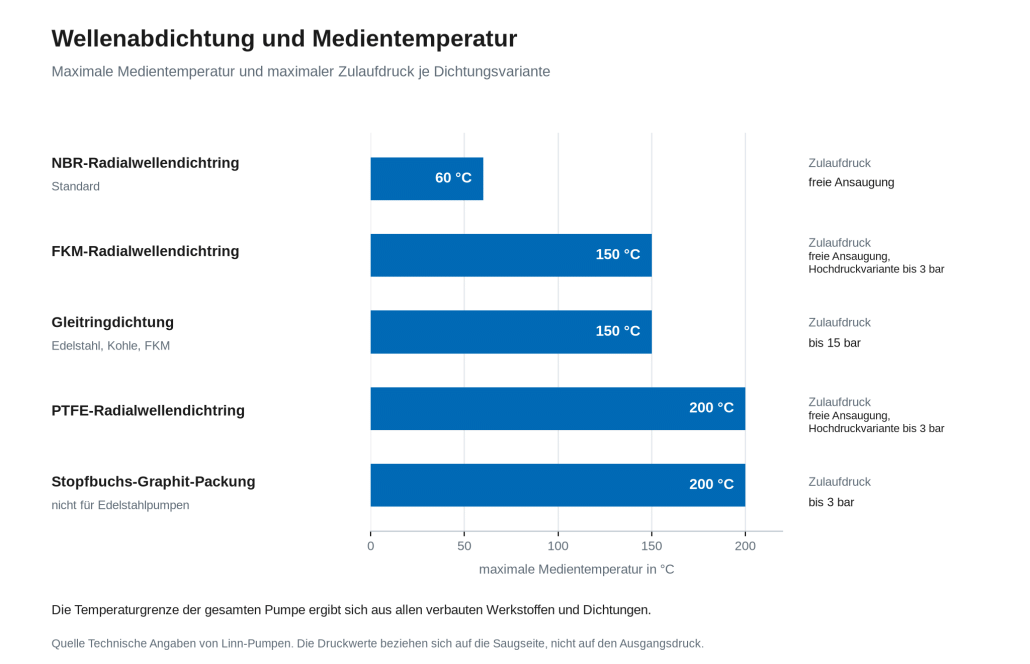
In addition to temperature, the inlet pressure at the shaft is also important. A standard radial shaft seal is designed for free intake. If the oil flows with a pre-pressure, a high-pressure variant is required up to 3 bar or a sliding ring seal up to 15 bar. This value applies to the suction side and not to the pressure generated by the pump.
The seal is not the only limiting factor. The allowable temperature of the entire pump is determined by all the materials used. Depending on the seal material and material combination, the range of the F series is from −40 °C to 200 °C. The ambient temperature should be between −20 °C and 40 °C, and sharp temperature changes should be avoided.
The housing of the cast version is made of grey cast iron EN-GJL-250, gears and shafts made of tempered and ground tool steel 16MnCr5. The shafts are mounted in composite sliding bearings. Spherical cast iron EN-GJS-400-15 is available as a special version.
Correctly classify the amount of feed and pressure
The flow rate depends on the construction size and the rotational speed. Each construction size has a fixed flow volume per rotation. This results in the theoretical flow rate.
Flow rate in l/min = Flow volume in cm³/U × rotational speed in min⁻¹ ÷ 1,000
In practice, the value is slightly lower because part of the oil flows back through the column and the tooth gaps do not always fill completely. With increasing pressure, the flow rate decreases.
The Gear-wheel flange pumps of the F series The flow rates range from 0.43 to 86.8 cm³/U. This corresponds to approximately 0.6 to 124 l/min at 1,450 min⁻¹. The pressure reaches up to 100 bar depending on the construction size.
The maximum flow rate and pressure are limits of the series and not a common operating point. Which pressure is possible with which flow rate depends on the construction size, viscosity, and drive. Additionally, the motor power limits the operating point for motor pumps.
The pipes also play a role. The performance specifications apply to a flow speed of no more than 1.5 m/s in the suction line and 4.5 m/s in the pressure line. Plan the suction line as short and tight as possible.
A gear pump also continues to deliver pressure even when the outlet is closed; the pressure then rises sharply. Therefore, an overpressure protection device must be installed in every system. The FU and DU versions have an overflow valve in the pump cover for this purpose. It transfers the oil from the pressure side to the suction side internally and serves as a safety device, not for permanent pressure control. Its upper limit is 20 bar for the sizes 1 to 3 and 10 bar for the sizes 4 and 5.
For higher pressures or a return to the tank, there is the external pressure limiting valve DB. It can be adjusted up to 100 bar and is designed for volume flows of up to 250 l/min. An overview can be found on the page Valves for gear pumps.
Heat transfer oil and lubricating oil in continuous operation
In heating and tempering circuits, the pump transports heat-carrying oil, often called thermal oil. The shaft seal must match the operating temperature and remains a point of wear and maintenance for the pump.
An alternative is the Gear pump with magnetic coupling FOM-MG. It transmits the torque via a MINEX S magnetic coupling. There is no dynamic shaft seal; the pump chamber is hermetically sealed to the outside. This eliminates the need for a shaft seal as a point of wear and maintenance. Typical media include heat transfer oils as well as odor-intensive or health-hazardous liquids.
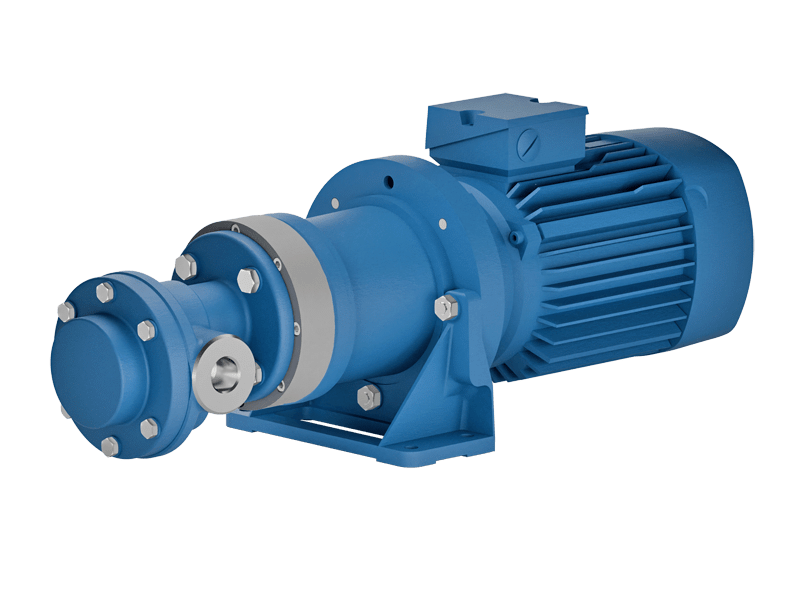
The FOM-MG provides flow rates from 0.6 to 124 l/min at 1,450 min⁻¹ and covers viscosities from 1.4 to 2,500 mm²/s. The motor power ranges from 0.25 to 18.5 kW; the data sheet lists media temperatures from −15 °C to 150 °C. Because the pump is made of gray cast iron, it is not suitable for acids and alkalis. More information about this application area can be found on the page Oils and heat transfer oils.
In the circulating and pressure lubrication of gearboxes, bearings, or compressors, the pump also runs continuously. For this purpose, install a prefilter before the pump and a safety valve. If the flow volume needs to be adjusted to meet demand, this can be achieved through the speed, for example with a frequency converter. For design information, see the page lubrication circuit.
Which version is suitable for your system
For oils, the F series in cast iron is the basis. The specifications differ primarily in the drive system and installation.
- F series as a pump head with a free end for your own drive, as Version D with additional pump foot
- Electric gear pumps FLM, FKM and FOM as ready-made motor pumps from 0.12 to 18.5 kW
- FAM for installation in containers; the pump head is located inside the container and the motor is located outside
- Gear motor version G for highly viscous oils with low pump rotation speed
- Version i with a frequency converter mounted directly on the motor, if you want to adjust the flow rate based on the speed
- FOM-MG with magnetic coupling, if the shaft seal is to be eliminated as a wear point
For corrosive media with sufficient lubrication, there is additionally Stainless steel gear pumps from 1.4571. An overview of all construction types can be found on the page Gear pumps.
We need this operational data for the design.
With a few details, Linn Pumps will select the appropriate pump for your oil. Please provide the following information as much as possible.
- Oil type, preferably with a manufacturer's datasheet
- Viscosity at minimum temperature and operating temperature
- minimum and maximum media temperature
- desired flow rate in l/min
- Pressure on the printing side and inflow situation, i.e., free intake or inflow pressure
- Installation, drive and power supply
- Operating mode, for example continuous operation in the loop or refilling
Don't you know all the values? Please provide the information that is known to you. We will clarify the missing points together with you.
Request a pump design. Send us your operational data via the form Request pump design or call us at 02355 9029-29. We will determine the operating point for your pump and get back to you as soon as possible.
Frequently asked questions about the gear pump for oil
Which gear pump is suitable for oil?
For clean, lubricating oils, cast-aluminum external gear pumps such as the F series from Linn Pumps are suitable. They can pump media with a flow rate of 1.4 to 20,000 mm²/s. Which design is suitable depends on viscosity, temperature, flow rate, and drive.
To what viscosity does a gear pump add oil?
With a geared motor and low speed, a gear pump from Linn pumps can pump oil at up to 20,000 mm²/s. With a four-pole motor at 1,450 rpm, the limit varies depending on the construction size: 250 or 350 mm²/s. Linn pumps only allow values above 2,500 mm²/s after technical consultation.
What seal do I need for hot oil?
Up to 60 °C, the radial wave seal ring is made of NBR; for higher temperatures, FKM, PTFE, a sliding ring seal or a graphite piston seal are required. FKM and the sliding ring seal can be used up to 150 °C, while PTFE and graphite seal are suitable up to 200 °C. However, the limit of the entire pump is determined by all the materials used.
Can a gear pump run dry with oil?
No, dry running is not allowed. The pump needs the medium for lubrication. Although it is self-priming, it must be filled with oil before the first start-up.
Can I use thermal oil with a gear pump?
Yes, thermal grease is a typical medium for gear pump systems from Linn Pumps. The key factors are a seal that matches the operating temperature and the viscosity at cold start. If the shaft seal is to be removed as a maintenance point, the FOM-MG with magnetic coupling is an ideal solution.
