
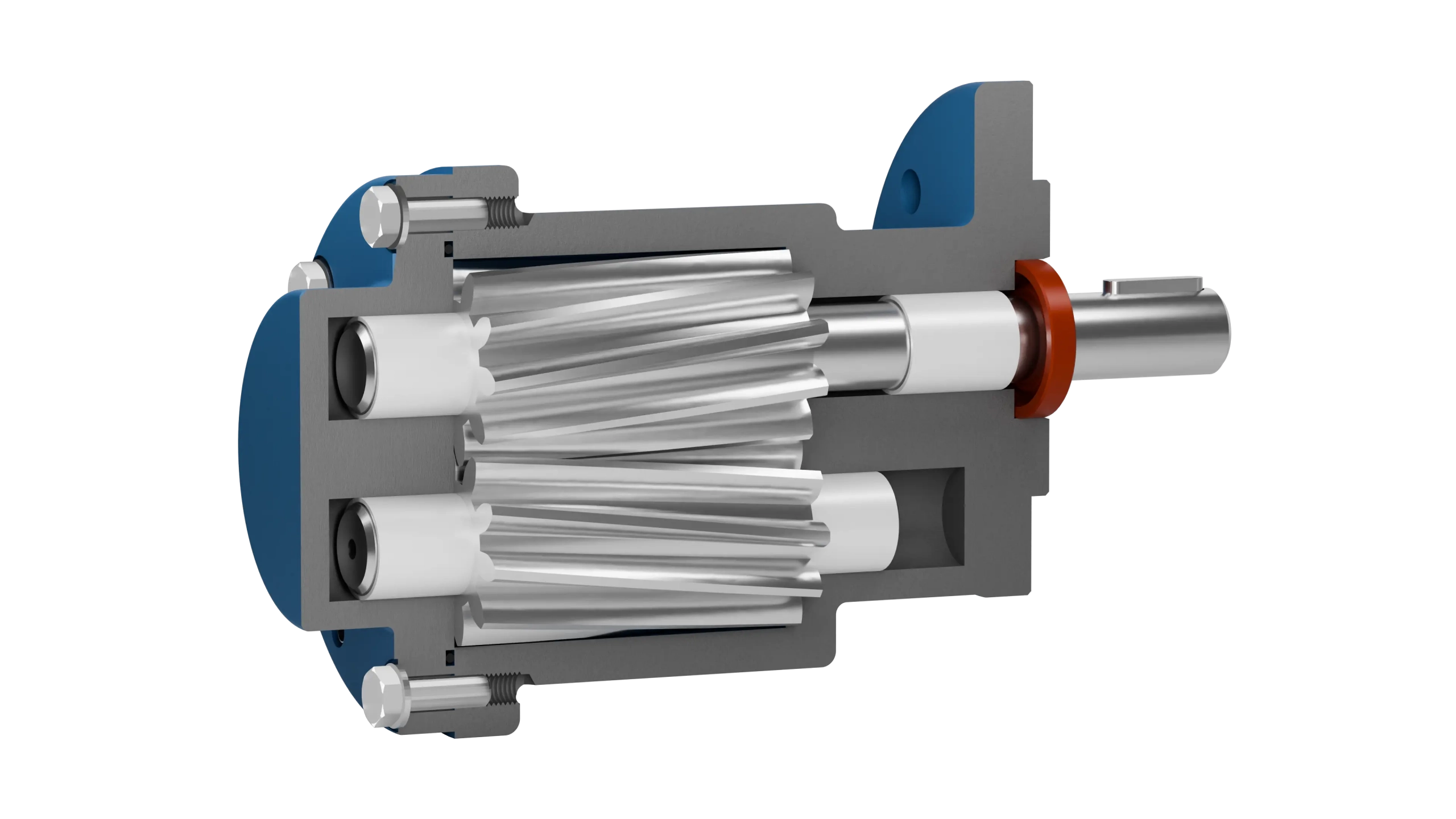
Gear pumps come in two basic designs: in an external gear pump, two externally toothed gears run side by side; in an internal gear pump, a small pinion runs inside an internally toothed ring gear. Both are positive displacement pumps and deliver a defined volume per revolution. They differ, however, in design, smoothness of operation and in how many components can wear.
In this article, two sectional graphics show how both designs deliver, where their strengths lie and which questions really matter when choosing. Linn-Pumpen manufactures external gear pumps itself, so at the end we also explain how our range is structured.
How an external gear pump works
Two gears of the same size mesh inside a housing with tight tolerances. The drive gear sits on the drive shaft, the second gear is driven by it and turns in the opposite direction. Where the teeth separate on the suction side, the tooth gaps open up. The medium flows in and fills them.
The medium is then carried in the tooth gaps along the outer housing wall to the pressure side. A common misconception is that it is pumped through the middle between the gears. That is where the teeth mesh and seal the pressure side against the suction side. On the pressure side, the teeth come together again and displace the medium into the pressure line.
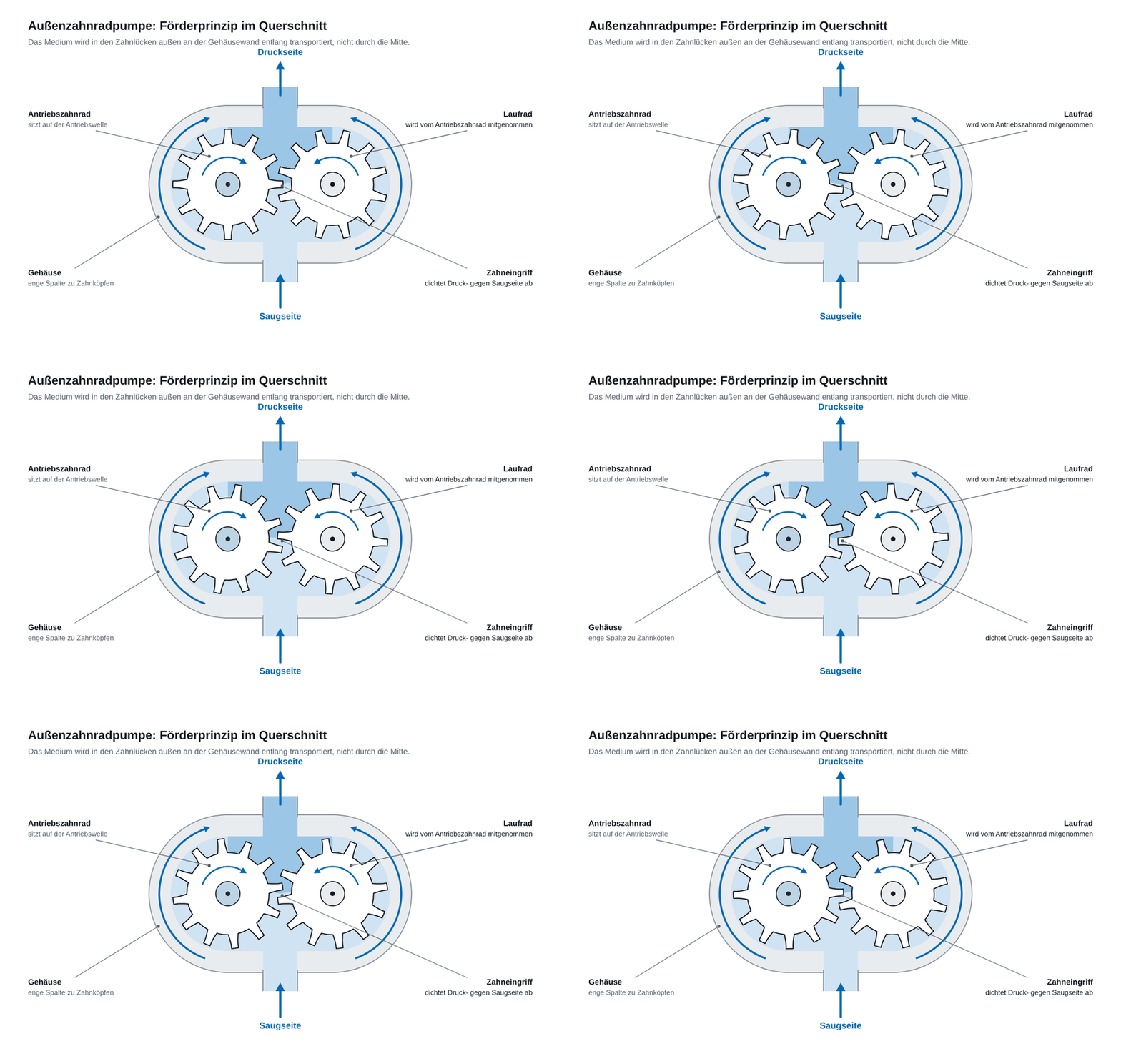
Because a fixed volume is delivered per revolution, the flow rate is almost proportional to the speed and depends only slightly on the back pressure. How well the pump seals is determined by the clearances between tooth tips, housing and side faces. With thin media and high pressure, a small part flows back through these clearances; with viscous media they seal better. The design needs only a few components. This makes the external gear pump robust and easy to maintain.
How an internal gear pump works
In an internal gear pump, an externally toothed pinion runs eccentrically inside an internally toothed ring gear. Both turn in the same direction. On one side the teeth mesh, opposite them sits a fixed, crescent shaped separator. Where the teeth separate, the gaps on the suction side fill up. The medium is carried in the tooth gaps of pinion and ring gear past the crescent and displaced where the teeth mesh again.
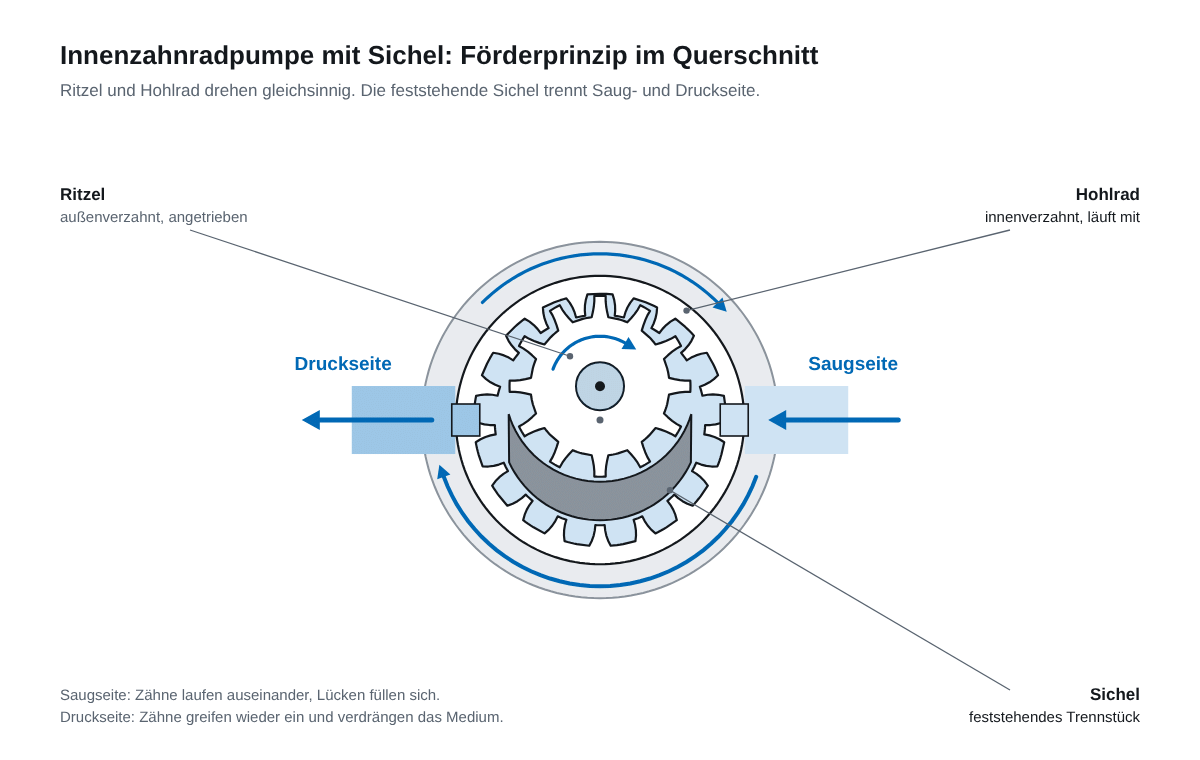
Because the teeth are in contact over a longer path, an internal gear pump usually runs more quietly and with less pulsation. It is compact, but with the ring gear and crescent it has more components that have to be manufactured and replaced when worn.
The differences at a glance
| Feature | external gear pump | internal gear pump |
|---|---|---|
| Structure | Two externally toothed gears side by side, counter rotating | Pinion inside the ring gear, same direction of rotation, with crescent |
| Smooth running and pulsation | Somewhat higher pulsation, depending on number of teeth and gearing | Usually quieter and lower in pulsation |
| Components | Few parts, simple design | More parts, additional ring gear and crescent |
| Maintenance | Gears, bearings and seal easily accessible | More complex, the crescent is an additional wear part |
| Installation space | Somewhat wider, as the gears sit side by side | Compact and round |
Both designs are self priming, deliver against pressure and are suitable for viscous media. Which design makes sense is therefore rarely decided by the principle alone, but by the operating data.
Which design suits your application?
It always starts with the medium. Viscosity and temperature determine which speed is permissible, which pump size is needed and how much motor power the pump requires. The more viscous the medium, the slower the pump has to run so that the tooth gaps on the suction side still fill completely. Whether the medium lubricates or is corrosive decides the materials of housing and gears.
Next come flow rate and pressure. Both belong to the operating point and are considered together, not as separate maximum values. Because gear pumps are positive displacement pumps, every system also needs pressure limitation so that no impermissible pressure builds up when the pressure line is closed.
Smooth running, pulsation and installation space are where an internal gear pump can have the edge, for example in noise sensitive environments. Where a simple, robust design, good spare parts supply and uncomplicated maintenance count, the external gear pump is usually the obvious choice. In lubrication circuits, with thermal oils, for transfer tasks and in many applications in machine and plant engineering, this is the norm.
External gear pumps from Linn-Pumpen
Linn-Pumpen manufactures external gear pumps in Schalksmühle as a modular system. The pump base is available in grey cast iron (F), in stainless steel 1.4571 (E/F) and in stainless steel with PEEK gears (E/F-PEEK). Within each base, the right version is configured from pump size, design and motor type and equipment, for example without motor with a free shaft end, as a motor pump or with Magnetic coupling. The version with magnetic coupling works without a dynamic shaft seal, and the pump chamber is hermetically sealed from the outside.
The range covers flow rates up to 124 l/min at 1,450 min-1 . As standard, we design our gear pumps for viscosities from 1.4 to approx. 20,000 mm²/s and, depending on the version, for media temperatures from about -40 °C to +200 °C. On the cast iron versions, a bypass valve can be integrated directly.
Frequently Asked Questions
Are gear pumps self-priming?
Yes, internal and external gear pumps are self priming by design. The achievable suction lift, however, depends on the medium, viscosity, temperature and suction line. With oils and highly viscous media it decreases. A short, sufficiently sized and leak tight suction line is decisive.
Which design is better for highly viscous media?
Both designs can handle highly viscous media. What matters are pump size and speed: as viscosity increases, the speed has to drop so that the tooth gaps fill completely. For very viscous media, slow running drives such as a geared motor are therefore an option.
When is an internal gear pump the better choice?
When particularly low pulsation, quiet running or a very compact installation space are the priority. In return, you accept more components and more maintenance effort.
Does a gear pump need a pressure relief valve?
Yes. A gear pump keeps delivering even against a closed pressure line, and the pressure then rises until the pump or system is damaged. A pressure relief valve in the system or a bypass valve on the pump protects against this.
Conclusion
External and internal gear pumps work on the same displacement principle. The external gear pump scores with a simple, robust design and easy maintenance, the internal gear pump with smooth running and a compact design. Which pump fits depends on the medium, viscosity, temperature, pressure and flow rate. Send us these operating data and we will size the right gear pump for your application.
