
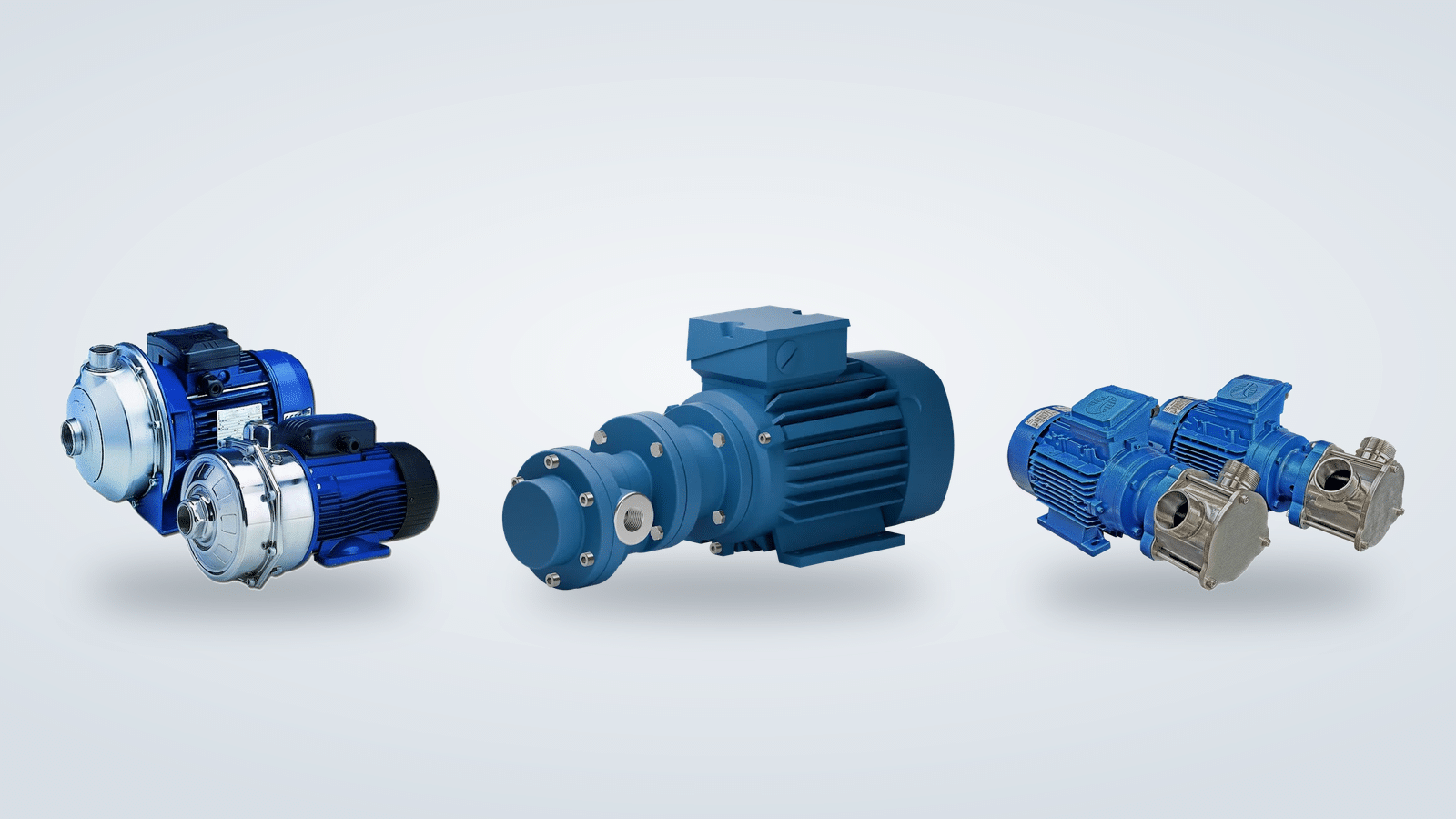
Cooling water in a cooling circuit, heat transfer oil in a tempering system, syrup from an IBC. Three conveying tasks, three different pump types. Which pump is suitable is decided less in the catalog than in the medium and operating data of your system.
This guide introduces the three pump types that Linn-Pumpen supplies: centrifugal pumps, gear pumps and impellers pumps. It shows you what each type is suitable for, where its limitations are and which pump is suitable for which medium.
Which pump for which medium?
The overview sorts typical media and tasks into the three pump types. It does not replace a design, but quickly shows in which direction the selection is going.
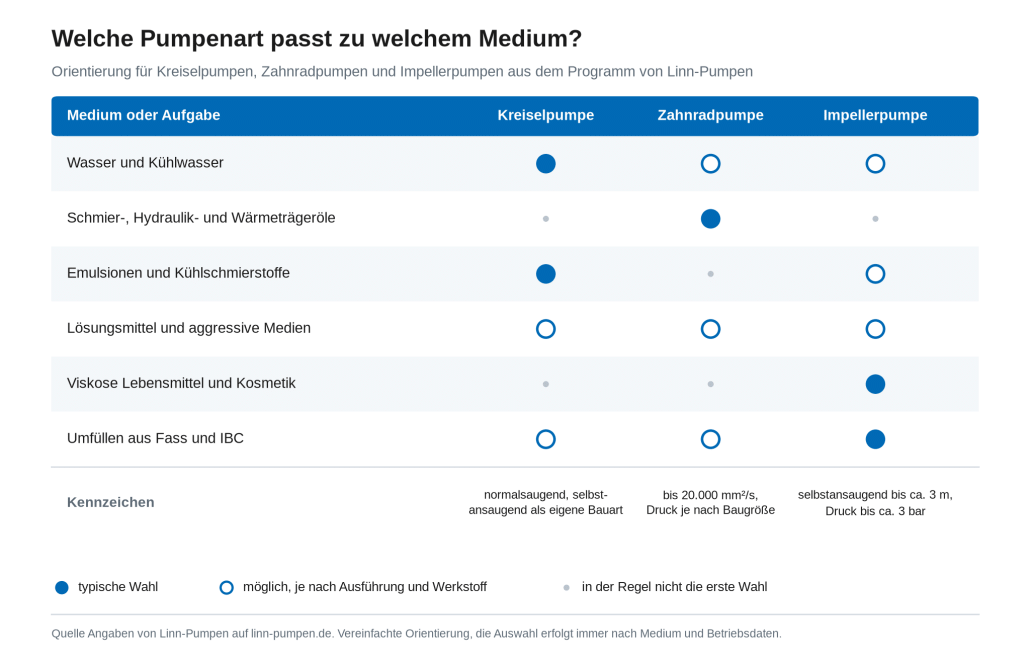
For water and cooling water, the centrifugal pump is usually the most economical solution. Impeller pumps are suitable for transferring fluids, while gear pumps with PEEK gears are used when a defined flow rate is required. Lubricating oils, hydraulic oils, and heat transfer oils are the classic applications for gear pumps. For heat transfer oils, Linn-Pumpen specifies temperatures up to approximately 200 °C; the sealing variant depends on the medium temperature.
Emulsions and cooling lubricants on machine tools usually use immersion pumps or other centrifugal pumps; more about that on the page. Coolant pumps for emulsions and cooling lubricants. Viscose food products such as sauces, creams or syrups are supported by the impeller pump in hygienic design. There is no food approval for the standard range of gear pumps.
For solvents and chemically aggressive media, the material determines the choice of pump type first and only then the type of pump. For gear pump applications, the stainless steel versions are suitable; for lubricants with stainless steel gears, for lubricants with PEEK gears, where lubrication is minimal or not required at all. We assess the resistance of all media-contacting materials on a case-by-case basis. For more information, see the page Chemical pumps for solvents and aggressive media.
Two principles of action as a starting point
All common types of pumps can be classified according to two principles. Centrifugal pumps, also known as flow pumps, accelerate the fluid with a rotating impeller and convert the speed in the housing into pressure. Their flow rate depends strongly on the head that the system requires. Conversely, displacement pumps compress the medium in chambers and push it from the suction side to the pressure side. Per rotation, they pump out an almost solid volume, even when the ambient pressure increases.
Among the displacement pumps, in addition to gear and impeller pumps, there are also piston, diaphragm, screw, eccentric screw and hose pumps. The principle of operation is the first filter to be considered when selecting a pump. Next, viscosity, temperature, flow rate, pressure and installation conditions determine the choice.
Centrifugal pumps for water and thin-fluid media
Centrifugal pumps continuously and uniformly circulate low-viscosity liquids such as water, cooling water and process water. They are the usual choice for water supply, pressure boosting, cooling and heating circuits, as well as for slightly contaminated media such as emulsions or cooling lubricants. With increasing viscosity, however, they lose significantly in flow capacity and efficiency.
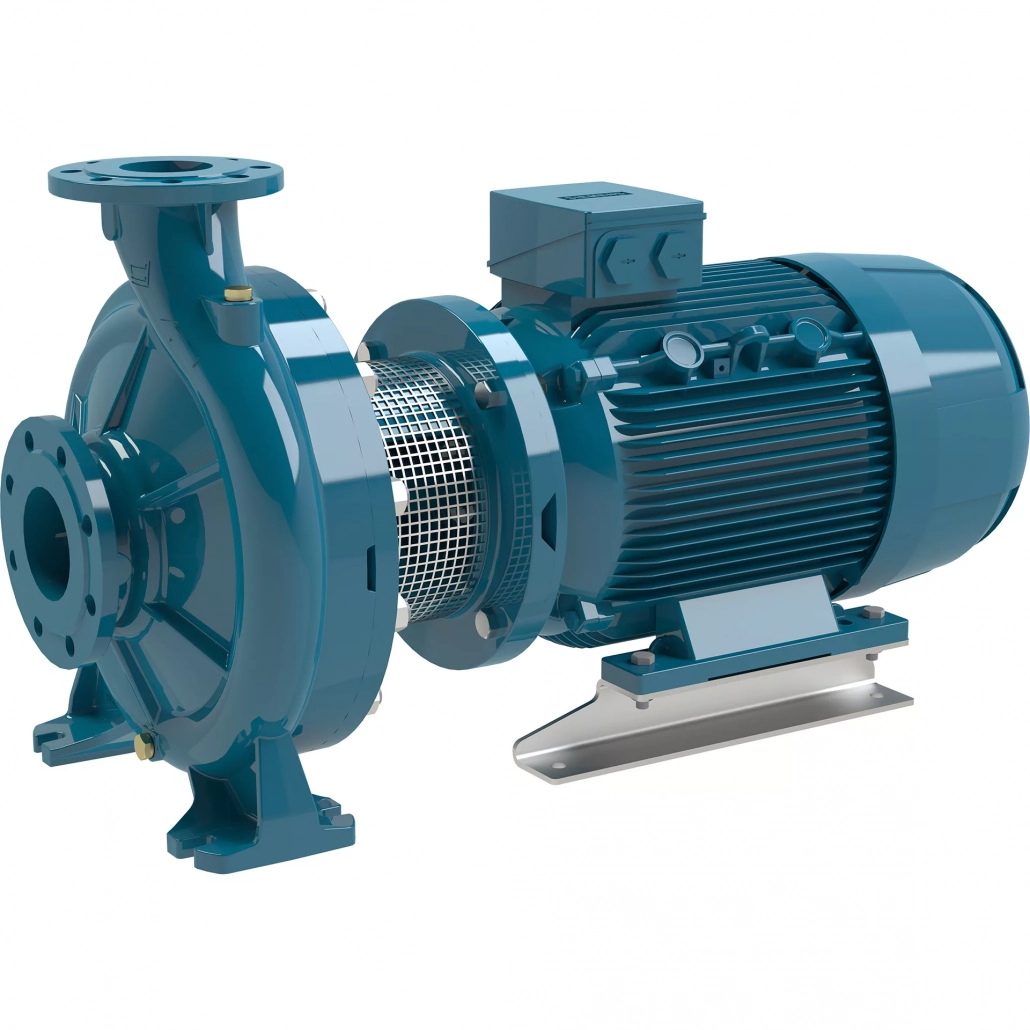
Within the centrifugal pumps, the design depends on the head and installation situation. One- and two-stage pumps cover supply, cooling and circulation at moderate heads. Multistage pumps They line up several impeller units one after another, thereby achieving high heads with moderate flow rates. Peripheral pumps deliver small flow rates at comparatively high pressures, but only for clean, non-abrasive media. Immersion pumps They are installed at the top of the tank and supply, for example, coolant to machine tools. On the other hand, submersible pumps operate entirely in the medium; underwater pumps pump water from wells.
Most centrifugal pumps are normally suction-type. The pump housing and suction line must therefore be completely filled with medium before starting. If the pump is above the liquid level or air enters the suction line, the pump must be stopped immediately. self-priming centrifugal pumps the correct type. They also require a first fill before they can be put into operation. All types can be found in the overview of the Centrifugal pumps.
Gear pumps for oils and viscous media
Gear pumps are among the rotating displacement pumps. Two interlocking gears transport the medium into the tooth gaps to the pressure side. The flow rate follows the rotational speed and remains largely constant with increasing pressure. Therefore, gear pumps are the typical choice for lubricating oils, hydraulic oils and heat transfer oils, for lubrication circuits and for dosing tasks.
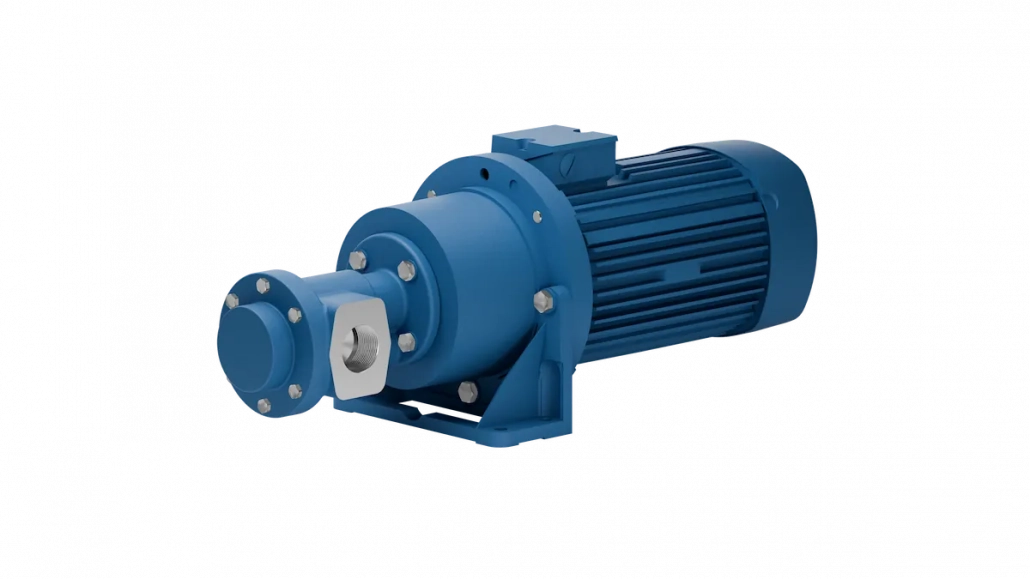
The Gear pumps from Linn-Pumpen in grey cast iron cover flow rates from 0.6 to 124 l/min at 1,450 min⁻¹ and viscosities from 1.4 to 20,000 mm²/s. In the grey cast iron version, the allowable maximum pressure depends on the construction size and is 10, 50, 70 or 100 bar. In the motor pump version, the motor power additionally limits the pressure, and maximum flow rate and maximum pressure do not apply simultaneously. The relationship between viscosity and speed is crucial. The thicker the medium, the slower the pump must run so that the tooth gaps can be completely filled. Therefore, the gear motor version G is available for very viscous media. Read more in the article Gear pump for oil.
Water and other non-lubricating media are more demanding for gear pumps because the medium lubricates the gears. For aqueous media, there are the Stainless steel gear pumps with PEEK gears, described in the article PEEK gears in gear pumps. For the stainless steel version, Linn-Pumpen specifies lower pressure limits than for grey cast iron. With PEEK gears, the maximum pressure is 10 bar, with stainless steel gears for corrosive but still lubricious media at 20 bar. The value of 20 bar applies to all stainless steel models E/F, E/FLM, E/D, E/FKM, E/FOM and E/FAM. Solid and abrasive particles are not well tolerated by a gear pump; for this reason, a different pump type is more suitable. Although the pumps self-priming, they are not suitable for dry running; any dry running is not permissible.
Impeller pumps for refilling and for sensitive products
The impellor pump is also a displacement pump, but it operates with a flexible rubber impeller. An eccentric inner contour of the housing shapes the blades with each rotation. This creates chambers that fill on the suction side and empty on the pressure side. The pump thus draws itself, through a correctly designed suction line up to approx. 3 m suction height, and is driven by a change in direction of rotation in both directions.
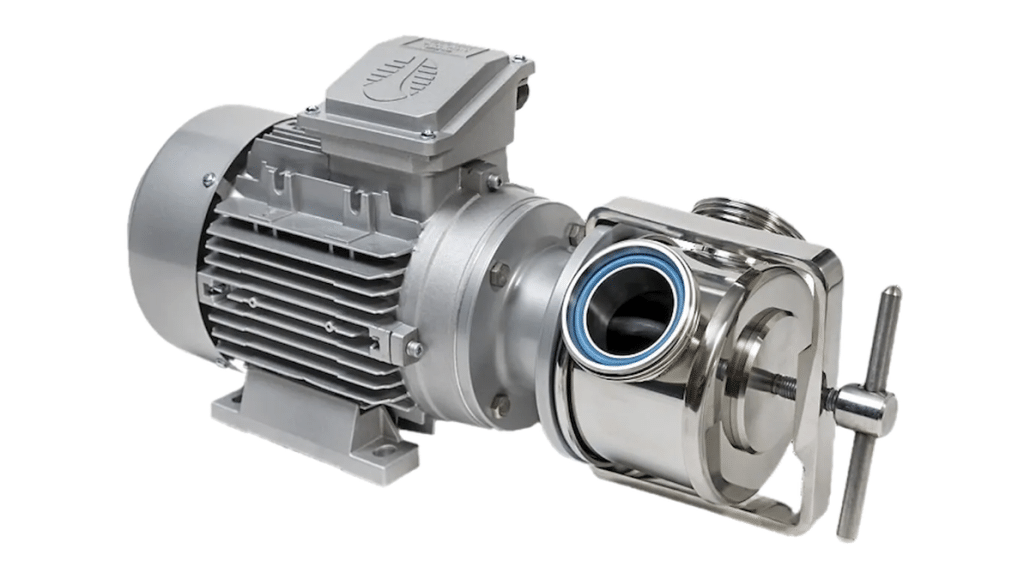
These properties make Impeller pumps for the right choice for the Transferring from barrel and IBC and for sensitive, even viscous products. Linn-Pumpen delivers them with flow rates of up to 333 l/min. Hygienic design With the R-5, R-10 and R-20 series of pumps, a pump housing is made of AISI 316L stainless steel and an impeller made of FDA-compliant nitrile. It can be disassembled without tools and is used for food, beverages and cosmetics. The FDA compliance thus applies to the hygienic design and not to all impeller pumps in general. The industrial version has a housing made of brass or AISI 304 stainless steel and an impeller made of neoprene, nitrile, Hypalon or EPDM.
The limits are in terms of pressure and hard particles. The pressure reaches approximately 3 bar, and with increasing viscosity the flow rate decreases. Strong abrasive media and continuous high-pressure circulations are not an application area for impeller pumps. Because the medium lubricates and cools the impeller, the pump can only tolerate short periods of dry operation during suction. It is not suitable for continuous dry operation; heating and wear can damage the impeller and the sliding ring seal. The impeller itself is a wear part; its service life depends on material, medium, temperature, and dry running times.
These details determine the selection.
The more detailed the operating data are, the more reliable it is to determine the appropriate pump type. For a recommendation, we primarily need this information.
- Medium with viscosity at operating temperature, density, and possible solid or gas components
- Flow rate in l/min or m³/h
- Funding amount or differential pressure, as well as the pressure conditions on the suction and pressure sides
- Installation situation with suction height or inlet, line lengths and placement
- Requirements for materials and hygiene as well as the electrical data
You do not need a type designation for this. We will clarify the missing values together with you.
Request a pump design. Send us your operational data via the form Request pump design or call us at 02355 9029-29. We will check which pump type is suitable for your medium and will provide a technically justified proposal.
Frequently asked questions about pump types
What types of pumps are there?
Pumps are classified according to their operating principle into centrifugal or flow pumps and displacement pumps. Centrifugal pumps include single- and multi-stage, self-priming, peripheral, submersible and immersion pumps. Displacement pumps include, among others, gear, impeller, piston, diaphragm and eccentric screw pumps.
Which pump is suitable for viscous media?
For viscous media, displacement pumps are usually more suitable because the flow rate of a centrifugal pump drops significantly with increasing viscosity. The gear pumps from Linn-Pumpen can pump viscosities of up to 20,000 mm²/s depending on the design. The speed is adjusted to the viscosity.
Which pump sucks itself?
Gear pumps and impeller pumps are inherently self-priming as displacement pumps. In the case of centrifugal pumps, this only applies to self-priming designs; most are normally self-priming and require a filled inlet. Self-priming centrifugal pumps and gear pumps are filled with medium before first starting. Self-priming does not automatically mean dry running is safe. With Linn-Pumpen’s gear pumps, any dry running is not permissible; impeller pumps can only tolerate short periods of dry suction.
