
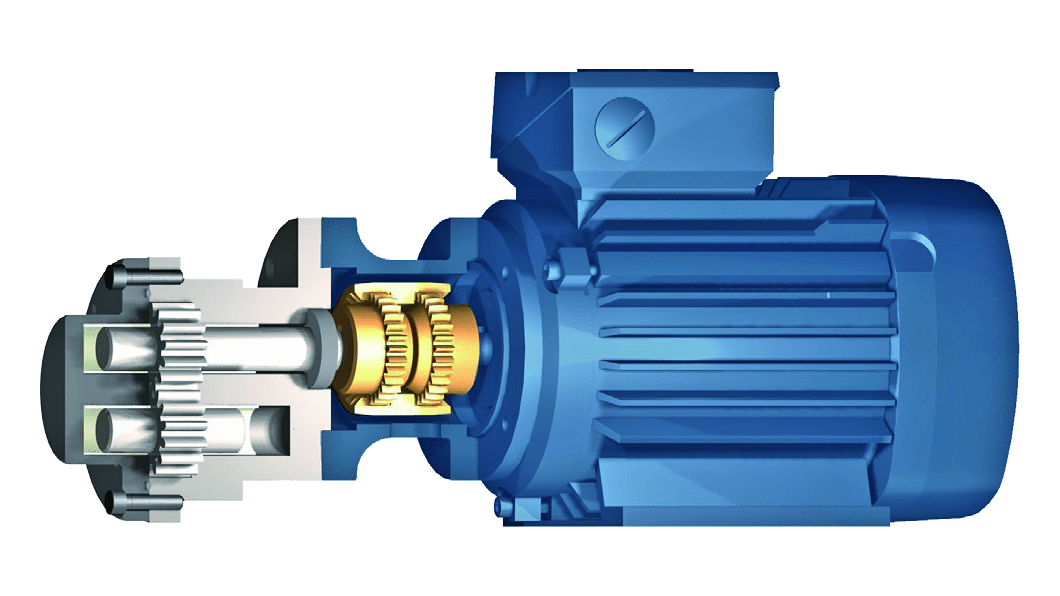
Those looking for a plastic gear pump usually have a medium that hardly needs lubrication. This includes water, aqueous solutions, or thin-fluid chemicals. For such cases, Linn-Pumpen combine a stainless steel housing with gears made of the plastic PEEK.
This guide shows you when PEEK gears are useful, what performance data the PEEK versions have, and what information we need for the design.
Plastic exactly where it is needed
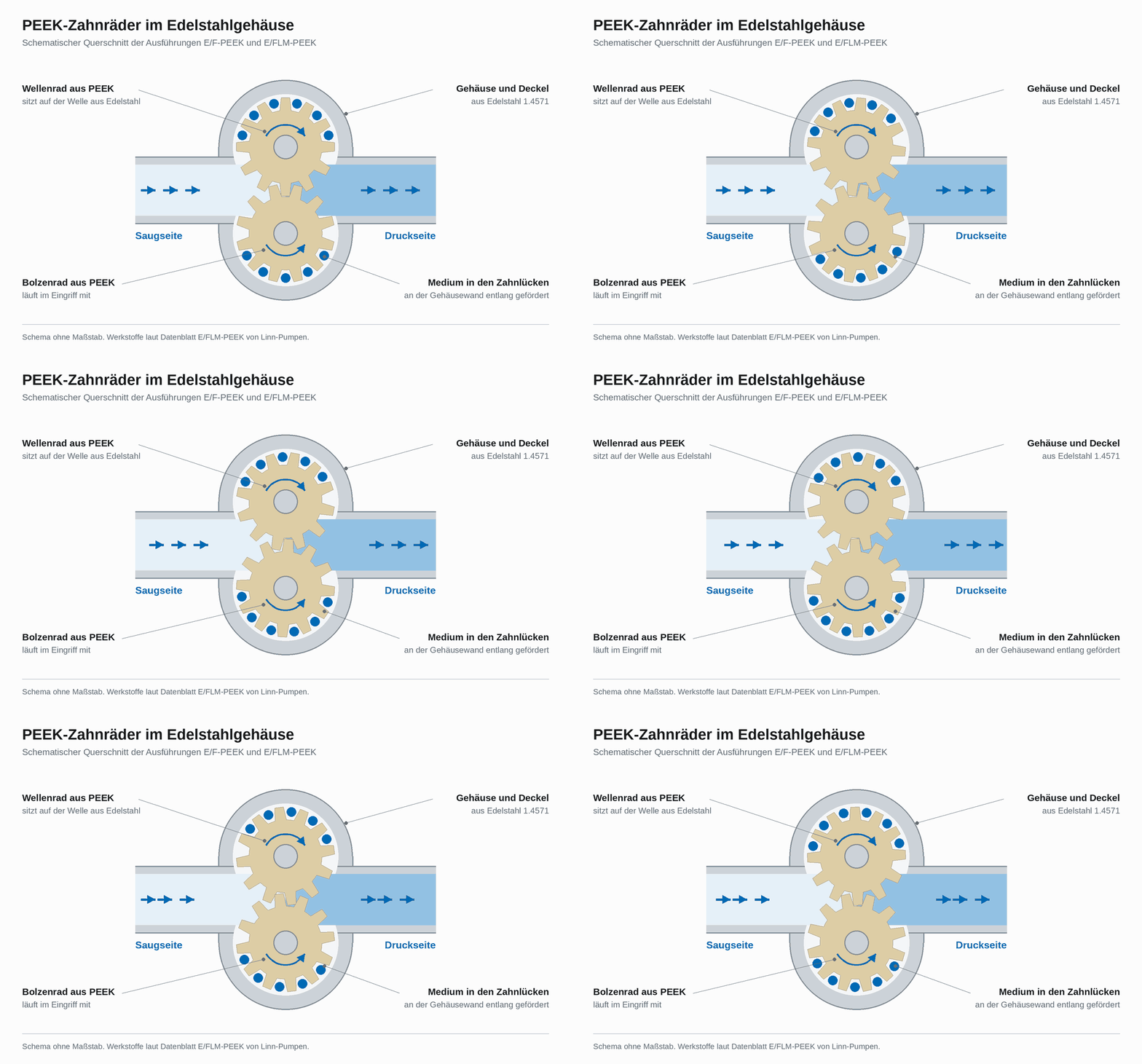
At Linn-Pumpen, the plastic sits on the gears. The housings, caps and shafts of the PEEK versions are made of stainless steel 1.4571, and the bearing bushings are stainless steel composite bearings. Only the two gears are made of PEEK.
The principle of the pump does not change this. Two gears spin in the housing and move the medium from the suction side to the pressure side through the tooth gaps. The article explains how this works in detail. What is a gear pump. The article shows which components are included in a gear pump. Gear pump assembly.
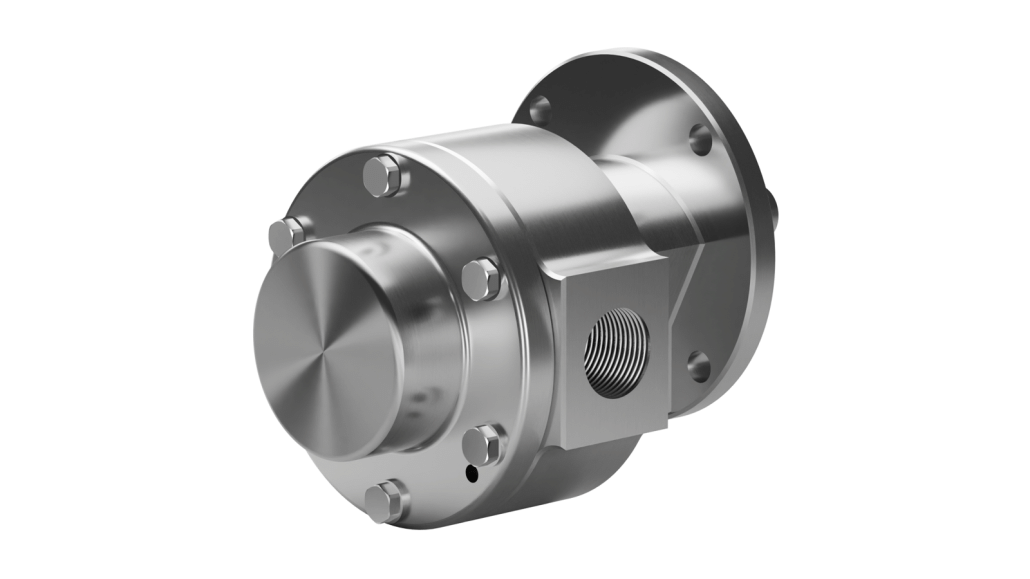
The pumps are self-priming and can be installed in any position. The suction and pressure connections are located laterally on the housing and have a threaded tube in the standard version.
The lubricity of the medium determines it
With a stainless steel gear pump, the first question is whether the medium is sufficiently lubricated. In the standard version, the gears are also made of 1.4571 stainless steel. This requires a minimum level of lubrication. If the medium is not sufficiently lubricated, the stainless steel gears will run dry against each other.
For these cases, there are PEEK gears. Linn-Pumpen uses them for low-to-no-lubricating media. Oils and heat transfer oils lubricate adequately; here, stainless steel gears run. Water, aqueous solutions, solvents, and thin-fluid chemicals, on the other hand, hardly require lubrication. A version with PEEK gears is tested for them.
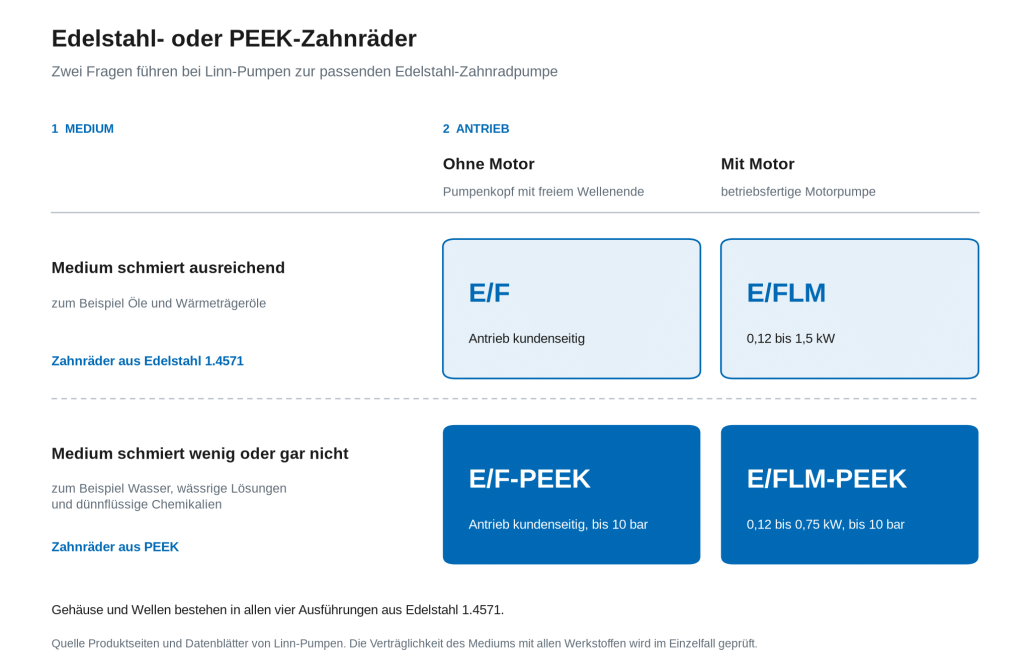
An overview of all versions with stainless steel and PEEK gears can be found on the page. Stainless steel gear pumps.
Which media are PEEK gears suitable for
Typical examples are aqueous media that do not or hardly lubricate. Linn pumps are used in, among other things, the chemical industry for acid and base handling, and for the dosing of chemicals in water treatment. An example from practice is mixtures of ethylene glycol and water in special machinery construction.
A general approval for all acids, alkalis or solvents is not associated with this. The medium must fit all media-contacting materials, i.e. stainless steel 1.4571, PEEK and the selected seal. Therefore, when using solvents, we always check the material resistance. You can read more about this on the page. Solvents.
Solid materials and abrasive components must not be present in the medium. There is no approval for the standard program for areas subject to explosion hazards according to ATEX as well as for food and hygiene requirements. Examples of applications from the chemical industry can be found on the page. Chemicals and the process industry.
Performance data of the PEEK versions
The PEEK versions cover a flow volume of 2.3 to 16.7 cm³/U. At 1,450 min⁻¹, this corresponds to approximately 3 to 24 l/min. The maximum pressure is 10 bar and is additionally dependent on the available motor power. The power specifications refer to hydraulic oil with 35 mm²/s at 50 °C.
The viscosity of the medium must be between 1.4 and 2,500 mm²/s. The more viscous the medium is, the slower the pump must run. With a four-pole motor at approximately 1,450 min⁻¹ Linn pumps can achieve up to 350 mm²/s, with a six-pole motor at approximately 950 min⁻¹ up to approximately 1,500 mm²/s and with an eight-pole motor at approximately 700 min⁻¹ up to approximately 2,500 mm²/s.
In the standard design, a radial-flow seal made of NBR seals the shaft. The medium temperature ranges from −40 °C to 200 °C, depending on the sealing material and the material combination. Additionally, there are available radial-flow seals with pre-mounted bearings, double-radial-flow seals, and plain-ring seals. The ambient temperature should be between −20 °C and 40 °C; shock-like temperature fluctuations should be avoided.
An overflow valve in the pump cover is not available in stainless steel. The pressure limit is solved at the plant side. Plan for it from the beginning, because a gear pump also pumps further against a closed outlet.
With or without motor
The second question concerns the drive. Is an engine or transmission available, or is the drive designed separately? The answer depends on the application. Series E/F-PEEK. It is a pump head with a free shaft end.
If you need a ready-to-connect unit, the motor pump fits. E/FLM-PEEK. The pump, motor, BoWex coupling and pump carrier are fully assembled. The motor power ranges from 0.12 to 0.75 kW, with single-phase or three-phase motors. Optionally, the motor pump comes with an integrated frequency inverter. It is installed as standard and pre-set to the desired operating parameters. This allows you to adjust the flow rate based on the speed, for example when Dosage with a uniform volume flow.
The other stainless steel designs E/D, E/FKM, E/FOM and E/FAM can also be manufactured with PEEK gears, from sizes 314 to 333. If the dynamic shaft seal is completely eliminated, there are the Gear pump with magnetic coupling in stainless steel, E/FOM MG. Its pump chamber is hermetically sealed to the outside, with PEEK gears available on request.
If you lubricate the medium sufficiently, you will find the same versions with stainless steel gears as the pump head. E/F and as a motor pump E/FLM. You can find an overview of all construction types on the page Gear pumps.
We need this operational data for the design.
With a few details, we check whether PEEK gears are suitable for your medium and which design is the best option. Please provide the following information as much as possible.
- Medium and concentration, preferably with safety data sheet
- Viscosity at operating temperature
- minimum and maximum media temperature
- desired flow rate in l/min
- Pressure on the discharge side and supply situation
- existing drive or desired motor pump with power supply
- Operating methods, for example dosing, stirring or transferring
Don't you know all the values? Please provide the information that is known to you. We will clarify the missing points together with you.
Request a pump design. Send us your operational data via the form Request pump design or call us at 02355 9029-29. We will examine the medium and materials and will contact you with a technically justified proposal.
Frequently asked questions about the plastic gear pump
What is a plastic gear pump in a Linn pump?
This refers to a stainless steel gear pump with PEEK gears. The housing, cover and shafts are made of stainless steel 1.4571, only the gears are made of plastic. This design is intended for low-to-no-lubricating media.
When does a gear pump need PEEK gears?
If the medium is poorly or not at all lubricated, for example water, aqueous solutions, or thin-fluid chemicals. Stainless steel gears require minimal lubrication. We check whether PEEK is suitable for your medium during design.
What pressure can a gear pump with PEEK gears generate?
The E/F-PEEK and E/FLM-PEEK designs operate up to 10 bar. The maximum pressure that is possible in a given case also depends on the available motor power.
Can I use water from a stainless steel gear pump?
As a rule, an implementation with PEEK gears is tested for this, because water hardly lubricates. The medium, temperature, pressure, viscosity, and operating conditions are crucial.
Is the PEEK version approved for food use?
No. There is no approval for the standard program for food and hygiene requirements. For such requirements, we review materials, seals, and surfaces together with you.

